
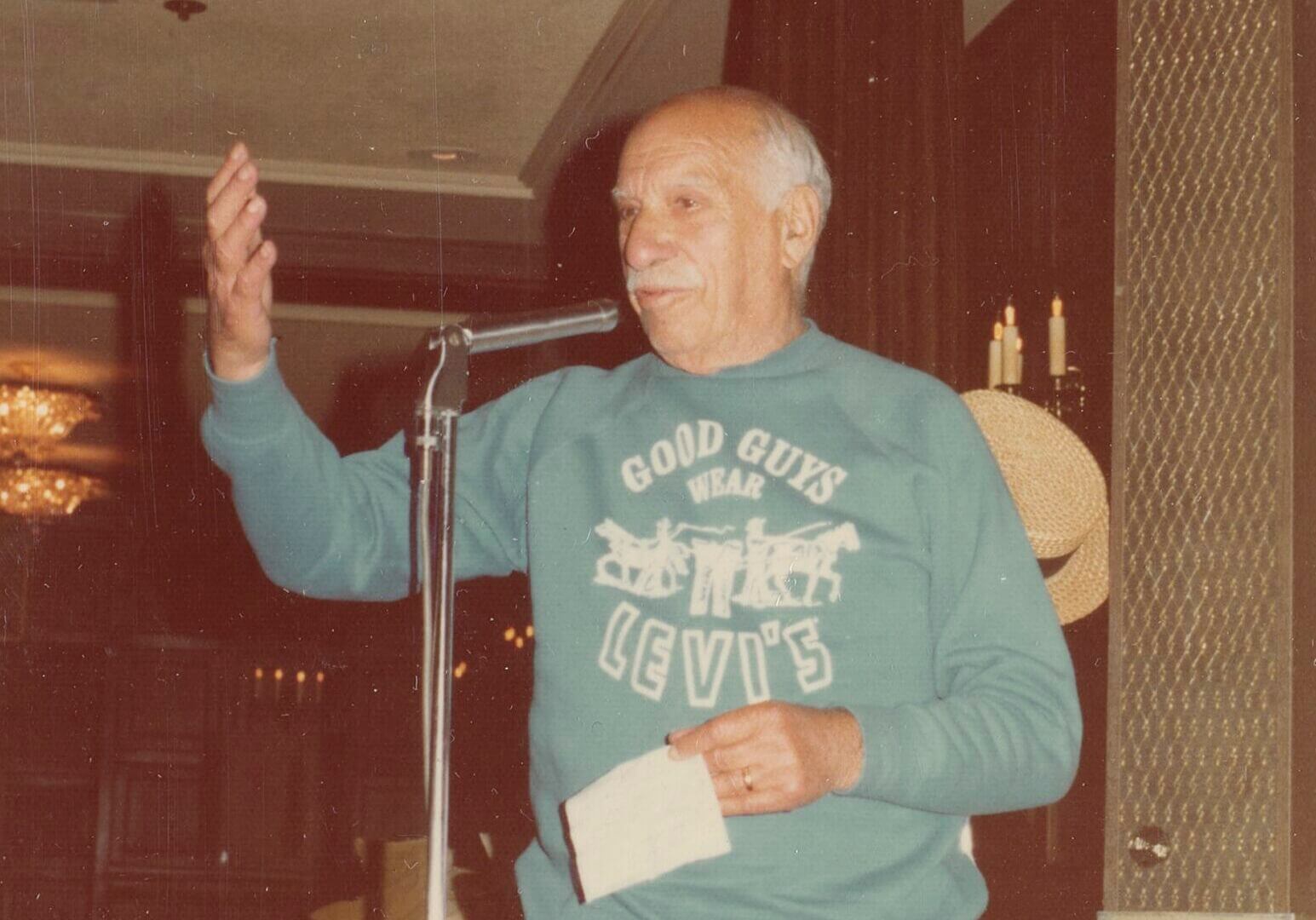
Photo: Daniel E. Koshland Sr. in 1974. Photo courtesy of Levi Strauss & Co. archives.
Watch a short video about the Koshland Program
Born in 1892 to a successful family in San Francisco, Daniel E. Koshland Sr. lived a wide and varied life. He earned an economics degree from the University of California at Berkeley and then moved to New York City, where he worked in banking. It was there that he first became involved in social work through a volunteer role coordinating English, literature, and music programs for Jewish boys. In 1917, he returned to San Francisco and later joined Levi Strauss & Company, where he served as vice president, treasurer, and CEO between 1955 and 1958. In addition to his successful business career, Koshland was fiercely dedicated to community-based philanthropy and a love of the region that he called home.
He served on a plethora of nonprofit committees and boards, including the United Negro College Fund, the Human Rights Commission, the San Francisco Juvenile Probation Committee, Planned Parenthood, the San Francisco Development Committee on Low-Cost Housing, and the Council on Civic Unity. Between 1947 and 1951, he also served on California’s Industrial Welfare Commission, where he helped determine minimum wage and working conditions for people in the Bay Area.
It was a phone call from Marjorie Elkus and Leslie Ganyard, respectively leaders of the Columbia Foundation and the Rosenberg Foundation, that catalyzed one of Koshland’s most significant philanthropic commitments to the Bay Area.
Elkus and Ganyard “called me one day with a far-reaching idea: ‘We want you to help start a community trust,’” Koshland said. “The phrase had a fine ring even then.”
Thus the San Francisco Foundation (SFF) was born in 1948—and 23 years after SFF’s inauguration, Koshland took action again to make sure the foundation could continue to operate for decades to come.
More Than Just a Donation
In 1971, Koshland wrote a letter to SFF saying that upon his death, he intended to leave the foundation a large portion of his estate. True to his word, when he died in 1979, he left SFF an unrestricted gift of $35 million—at the time the largest unrestricted endowment gift the foundation had ever received.
Koshland’s gift was a vote of confidence in the organization that he had helped found, build, and guide as a board member for 26 years.
After careful consideration, a group of SFF stakeholders, civic leaders, and Koshland’s closest friends, including Lew Butler and Sandy Tatum, approached SFF’s CEO and Board with a proposal to use a portion of his gift to create a program that would continue his philanthropic work in a way that reflected his values and—in the words of his daughter, the late Phyllis K. Friedman—his “quiet, unpretentious, and ennobling way of support.”
Those who attended the Koshland Program’s 1982 charter meeting included businessman and longtime ACLU executive William M. Roth; UC Berkeley architecture professor and founding director of the BRIDGE Housing nonprofit Richard Bender; California Pacific Medical Center bioethicist Albert R. Jonsen; Koshland’s son and UC Berkeley biochemistry professor Daniel Koshland Jr.; UC Berkeley political science professor William K. Muir; San Francisco Health Commissioner Rosabelle Tobriner; and housing activist Mary Lee Widener.
The result was the 1982 establishment of SFF’s Daniel E. Koshland Civic Unity Awards Program.
Supporting Unsung Heroes
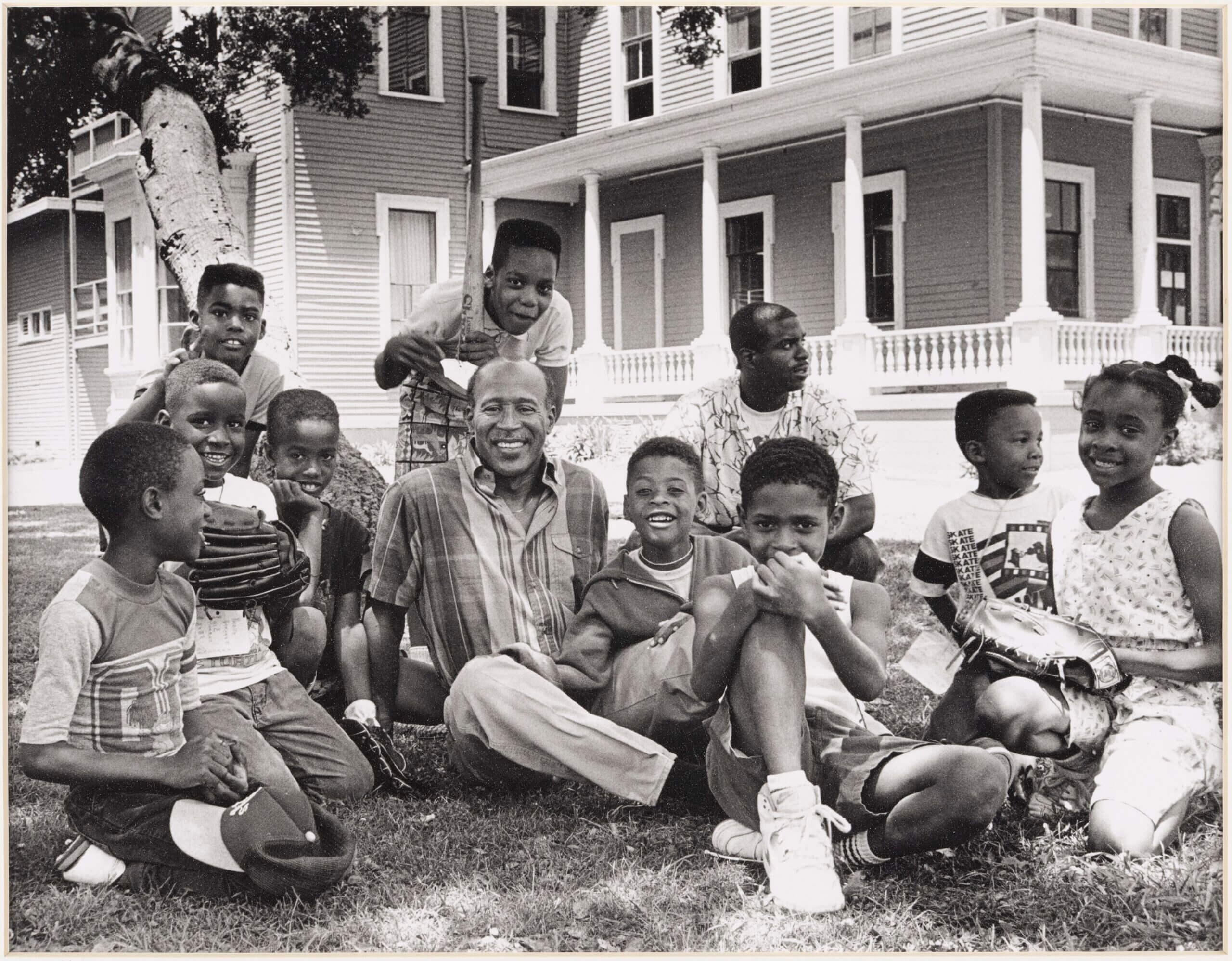

Photo: Koshland West Oakland Fellow William McDavid in the early 1990s. Photo by Kathy Sloane.
The Koshland Program seeks to promote unity and help solve problems in Bay Area communities by supporting individuals at the local level with funding and professional development, as well as networking opportunities.
“It’s identifying those unsung leaders, those folks who are making differences in the community but don’t get recognized because they’re just doing the work for the commitment to community and the passion that they have for their neighbors,” said Koshland Program Director Retha Robinson.
Initially, the program recognized individual neighborhood leaders— Koshland Fellows—with funding for organizations to which they were connected. It has since refined its focus: While Koshland Fellows are still recognized and receive monetary awards, the program is now more collaborative and community-centered, and its five-year funding is provided to a single project or organization that the Fellows identify and work on together.
A diverse group, Koshland Fellows are chosen using a people-centered, grassroots-influenced process. Cohorts have included pastors, bus drivers, community organizers, crossing guards, parents, nurses, and students.
“What has always been the key to the Koshland Committee is that a lot of philanthropy is very worthwhile, but it’s dealing with established organizations, established leaders, established people,” said the late Lew Butler, one of Koshland’s friends and mentees, who helped create the Koshland Program and served on its committee between 1982 and 1995. “The Koshland Committee reaches down way below that level to so many people that are critical to communities that are doing good stuff every day that you never hear about in the newspapers. They’re known in their community, but they’re not known outside the community.”
Catalyzing Change
The Koshland Program chooses a neighborhood for each five-year engagement based on a number of criteria. First, the Koshland Committee and community members provide their ideas. The committee examines where in the Bay Area SFF is not already active and reviews which neighborhoods are lacking in social services and need greater investments.
Once the committee decides on a neighborhood, its members meet with nonprofits and local leaders to learn more and eventually form a cohort of up to 12 Koshland Fellows who will work together with a five-year, $300,000 investment. Koshland Fellows receive professional development and leadership training and work together to create a neighborhood plan and project that the program will fund.
Over the years, the Koshland Program has supported the transformative music program at Benjamin Franklin Middle School in San Francisco—what the San Francisco Chronicle described in 1999 as “one of the most vital public school music programs in the nation”—and the nationally recognized youth development and violence prevention organization Omega Boys Club (now called Alive and Free) in the City’s Potrero Hill neighborhood. Koshland Fellows have also created and funded programs that have assisted students with their college educations, preserved local cultural heritage, and strengthened community resilience against displacement and gentrification.
Since its founding, the Koshland Program has supported more than 500 community leaders in more than 35 Bay Area neighborhoods. More than just a generous donation, Koshland’s gift has become the catalyst for a vibrant and vital program that supports neighborhood leaders in the Bay Area by empowering them to advocate as the foremost experts on what their own communities need.
An Understanding for the Future
Today, the Koshland Program remains at the heart of SFF’s work as a community foundation. But there was a time when the program’s future was uncertain. Soon after the foundation lost its 1986 petition to revise the terms of a large bequest, the organization was forced to transfer out a significant portion of its assets, lay off half of its staff, and pause the Koshland Program. In 1988, the program resumed operations under the visionary leadership of director Arnold Perkins. But the foundation’s overall direction during that era—focused more on donor contributions and asset growth than community impact and partnership—caused waves of staff to resign.
It was during this volatile period that those closest to the program, including co-founder William M. Roth, Koshland’s mentee Lew Butler, and Koshland’s daughter Phyllis K. Friedman, created a memorandum of understanding to ensure that the Koshland Program could never again be paused.
“The whole thing was just put on hold for … at least a year or longer,” Butler recalled. “And finally we got restarted, and the rest of the story has been all one big success for the Koshland Committee.”
Preserving Koshland’s Legacy for the Future
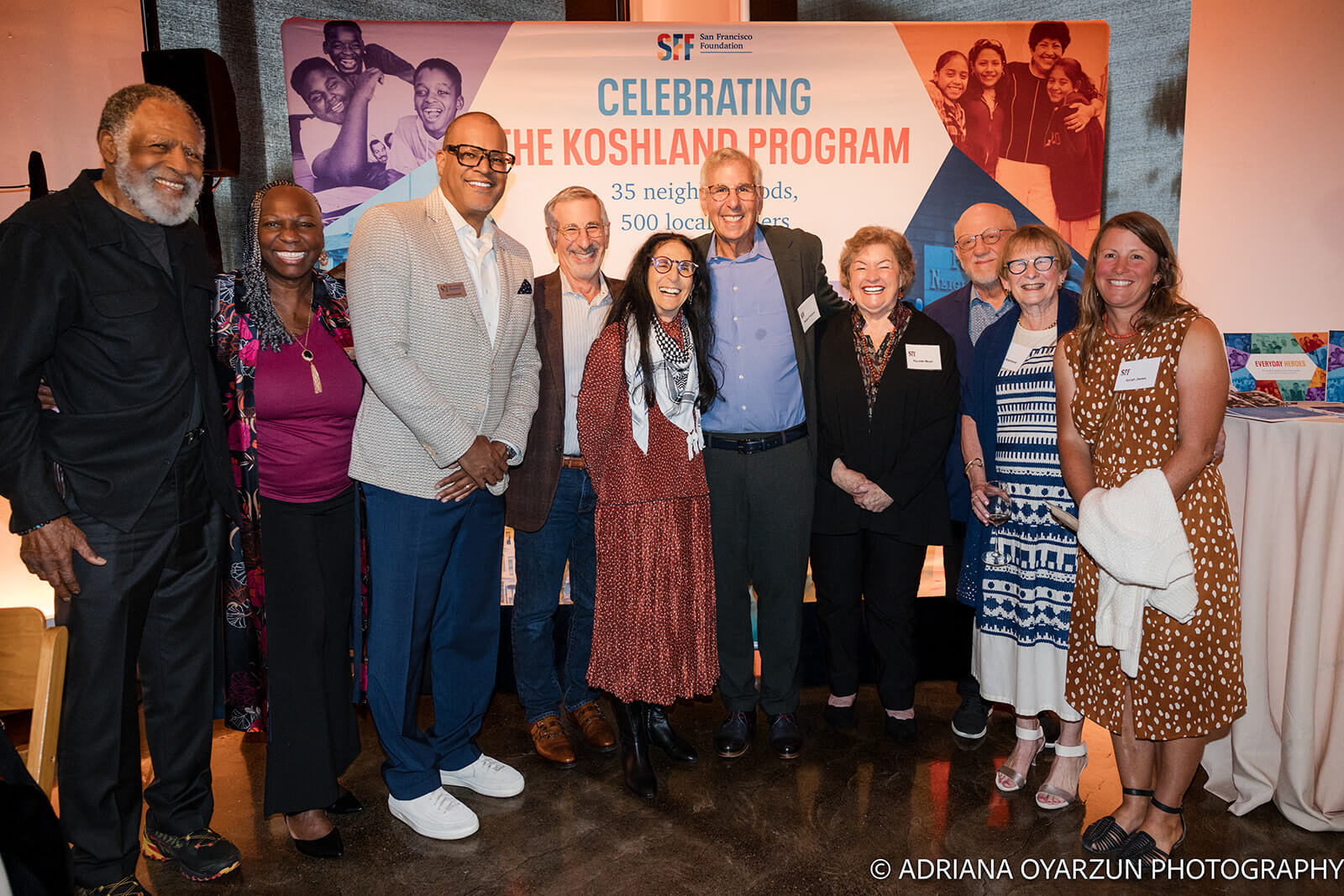
Photo: Celebrating more than 40 years of the Koshland Program in 2025. Left to right are Arnold Perkins, former Koshland Director; Retha Robinson, current Koshland Director; Fred Blackwell, SFF CEO; David, Ellie and Bob Friedman, Paulette Meyer, Jim and Cathy Koshland, descendants of Daniel Koshland. Photo by Adriana Oyarzun.
Daniel E. Koshland Sr. was deeply committed to social justice and innovation in philanthropy. But above all, he believed in people and the power of working together in community. Friends and relatives tell stories of how Koshland treated people from all walks of life—business associates, friends, a train station newspaper vendor, Levi’s factory employees, and more—with kindness and respect.
Today, Koshland’s legacy lives on not only in the program that bears his name but also in the committee that oversees it and the organization of which it is part. The Koshland Committee continues to include SFF stakeholders, activist academics, and community leaders—but in the spirit of family philanthropy and generational giving, it has also included Koshland’s next generation of family members. His daughter, Phyllis K. Friedman, was a beloved hands-on committee member between 1989 and 1994, and her son Bob Friedman served on both the Koshland Committee and as Chair of the San Francisco Foundation Board of Trustees.
Koshland recognized that his wealth gave him the “responsibility to reach out and do good things,” according to David Friedman, Koshland’s grandson.
“One of his sayings was, ‘Don’t be so modest, you’re not that important,’ which is, I think, the way he looked at himself, too,” said Bob Friedman. “He knew he was privileged, but he lived that by interacting with others and being extremely generous.”
What began as a way to use Koshland’s monetary gift to honor his philanthropy has grown into a dynamic and positive way for SFF staff, Koshland family members, committee members, donors, neighborhood leaders, and residents of the communities that SFF serves to carry on the legacy of a man who loved San Francisco, loved people, and loved giving.
When it came to philanthropy, Daniel E. Koshland Sr. believed in empowering people in order to bring about change. SFF shares his belief, and we’re committed to empowering not just community residents and leaders but also donors. SFF takes pride in partnering with donors and connecting them with the tools and expertise they need to turn their philanthropic visions into reality and help make the Bay Area a place where everyone can thrive.