
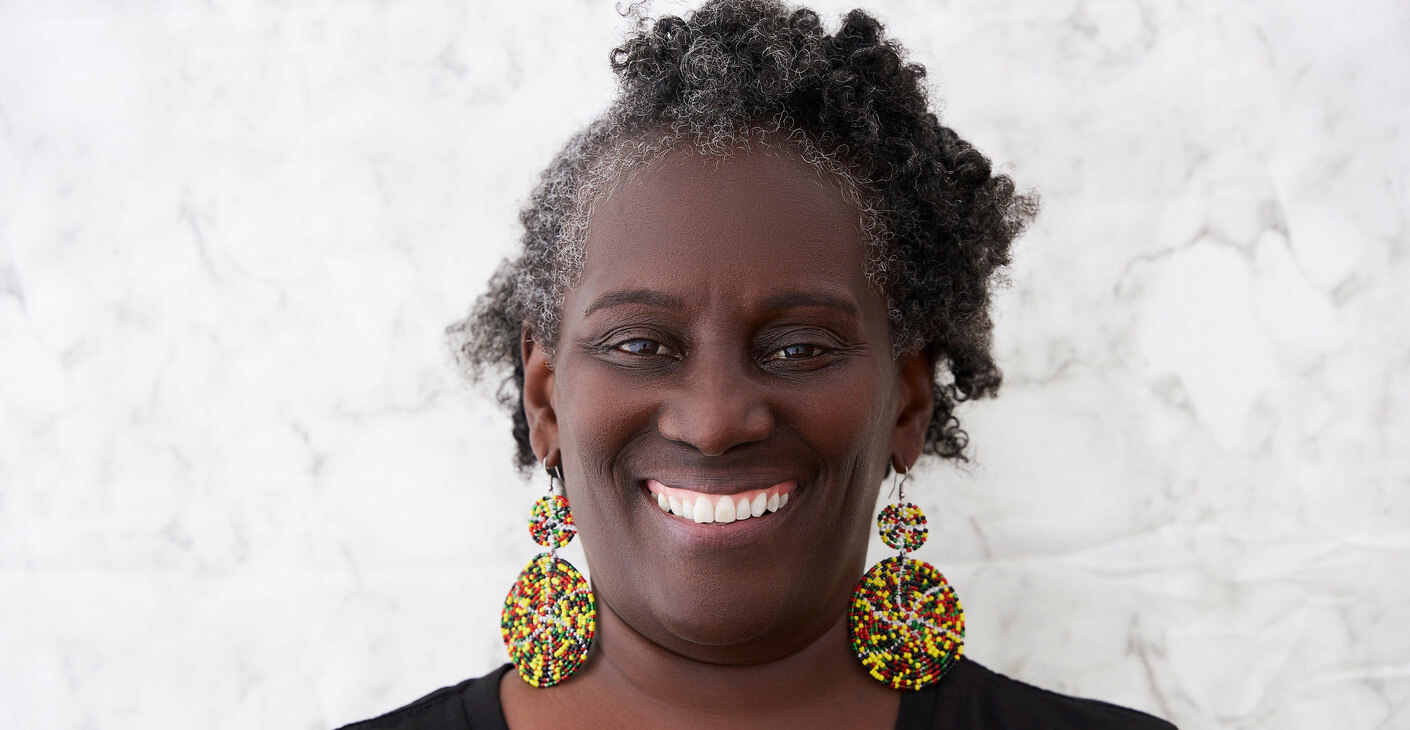
Growing up in East Oakland during the 1970s, one of Carolyn Johnson’s most vivid memories is of pancakes breakfasts on International Blvd. The daily breakfasts were organized by the Black Panther Party as part of their Free Breakfast Program for Children after the organization moved their headquarters to East Oakland. The program was one of the many ways that the Black Panthers assisted with basic needs that government programs failed to provide for the Black community. For Johnson, the pancakes – and the spirit behind them – made a lasting impression.
The daughter of a minister and social worker, Johnson’s childhood was steeped in community service. But despite her family’s dedication to the community, she says that multiple relatives in the Bay Area were pushed out of the region due to gentrification – the force of speculative real estate purchases that leads to the displacement of existing residents in a neighborhood. Her family members in Russell City, a Black neighborhood and unincorporated area that is now part of Hayward, were pushed out starting in the 1960s, when properties were taken by eminent domain. Not only did gentrification cause her family to lose their homes and generational wealth – it also caused the community to lose their neighborhood’s culture and sense of belonging. The fact that the trend has continued isn’t lost on Johnson; in the 2010s, the Bay Area lost 5,000 Black-owned households, according to the Bay Area Equity Atlas, a data resource SFF helped create.
All of these experiences led Johnson to dedicate her life to neighborhood community development. Known as “CJ” to those who know her, Johnson has held leadership roles at several nonprofits in the Bay Area, including the East Bay Asian Local Development Corporation, where she oversaw the organization’s commercial real estate portfolio. She is also a realtor and instructor in the business department at the College of Alameda.
Today, Johnson also leads the Black Cultural Zone (BCZ), an SFF grantee which promotes Black culture in East Oakland. BCZ primarily focuses on an area of roughly 40 by 40 square blocks in East Oakland and helps fight the displacement of the Black population in the neighborhood.
Her work at BCZ started when a member of Eastside Arts Alliance, also a longtime SFF grantee, reached out to her because of her unique expertise in real estate and leadership – and specifically, how physical space is fundamental to building community, culture, and belonging. When Johnson learned that BCZ wanted to purchase a building that was just a few blocks from where she grew up, she stepped up to join as BCZ’s first director.
“It’s personal, because East Oakland really is my home,” she says.
During the COVID-19 pandemic, BCZ pivoted in part to community health issues, collaborating with ROOTS Community Health, which focuses on health disparities in the surrounding neighborhoods. ROOTS is located across the street from Liberation Park, an outdoor space that holds a variety of community events, from roller skating to concerts, movies, and a market featuring local artisans. In the early months of the pandemic, East Oakland had one of the highest concentrations of COVID cases, but BCZ provided critical resources by holding outdoor events with free COVID tests, food distribution, and more.
Johnson hopes to stem the tide of Black displacement, retain and nurture Black culture in the neighborhood, and reinvest in the local economy. In addition, BCZ plans to turn the corner where Liberation Park is located into an affordable housing complex with a food hall. These offerings, which she describes as a microcosm of what every community should have, is in part to convey, “we are here, and we are here for the community,” she says.
Together with its many local partners, including the 40×40 Council, which includes the Brotherhood of Elders Network, East Oakland Youth Development Center, and ROOTS Health, BCZ is dreaming of what East Oakland can be.
When Johnson thinks about the Black Panther Party that has inspired her own commitment to Oakland, she reminds us that the Party’s goal wasn’t only basic rights for Black people, but a thriving and empowered community.
“The Black Panther Party’s 10-Point Plan for basic rights for Black folks still hasn’t been met,” she says, referring to ideas such as housing, education, and free healthcare. “There’s so much more that we need. The Black Cultural Zone and the collaborative is the continuation of that movement for justice for liberation – for equity, rights, and decency.”
Learn more about our Community Leadership Awards.
By Momo Chang, SFF consultant
