
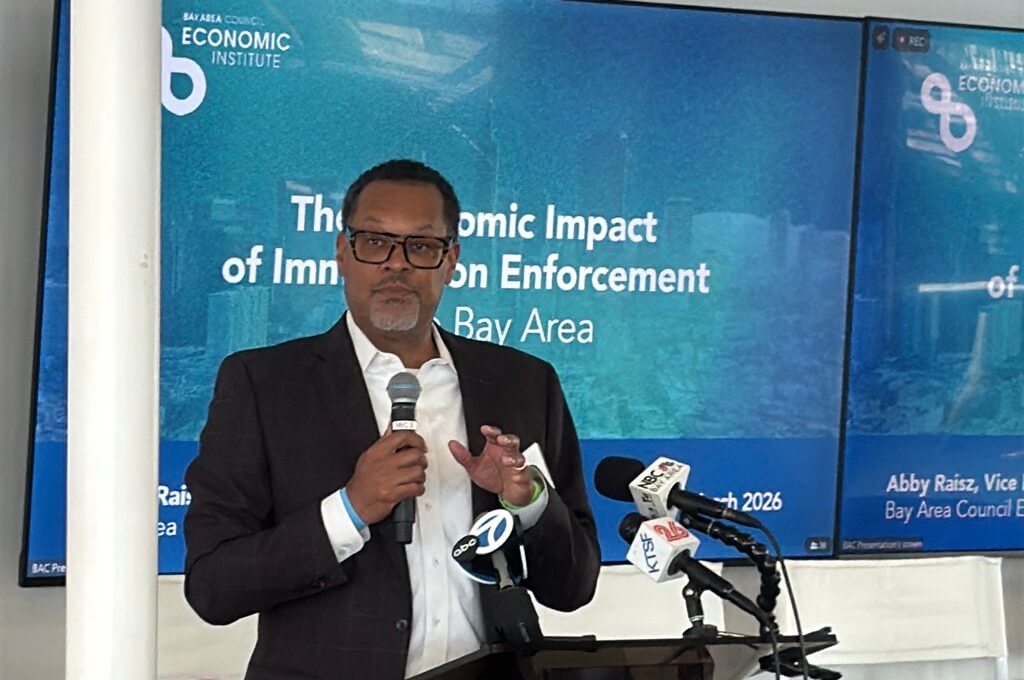
The San Francisco Foundation (SFF) is proud to support a new study by the Bay Area Council Economic Institute, The Economic Impact of Immigration Enforcement in the Bay Area. It finds that mass deportation could cost the Bay Area economy $67 billion annually. It highlights the critical role immigrants play across industries such as construction, hospitality, and caregiving, while exploring the deep interconnectedness of the Bay Area’s immigrant communities with the region’s economic and social fabric. It builds a foundation for how the economic impact of increased immigration enforcement reverberates throughout the Bay Area.
The findings are clear: protecting our immigrant families is inseparable from protecting the Bay Area’s economy itself.
A Region Built on Interdependence
The study shows that nearly 477,000 undocumented immigrants call the Bay Area home, many having lived here for decades, raising families, contributing to local culture, and participating in the workforce at exceptionally high rates—73%, even higher than native‑born residents. Their roots run deep across neighborhoods, schools, and industries.
These workers are not isolated to any one sector. They are foundational to industries already struggling to meet labor demand—construction, hospitality, caregiving, food service, manufacturing, transportation, and retail. In administrative and building support roles alone, undocumented workers make up 19% of the workforce, and more than 15% of those working in food service and accommodations. The Bay Area economy functions because these workers keep it running every day.
The Economic Stakes
The study estimates that if these workers were removed from the labor force through intensified enforcement or mass deportation, the Bay Area could lose up to $67 billion in annual economic output—approximately 5–6% of the region’s total GDP. These losses include not only the direct value of their labor, but the ripple effects across supply chains, consumer spending, and regional productivity.
Undocumented workers also contribute more than $8.4 billion in federal, state, and local tax revenues each year. These revenues fund schools, transportation, public health, and other essential services—investments that benefit every resident. Removing this population would deepen existing fiscal strains and widen budget gaps at a time when local governments can least afford it.
Families at the Center of Regional Stability
The Bay Area is home to 130,000 mixed‑status households, representing 536,000 residents, including 153,000 children. In these families, deporting a primary earner would slash household income by 69%, dropping the median from $117,000 to just $36,000. That is far below what is needed to afford even the basics in this region. The consequences would reverberate across housing stability, workforce participation, childcare access, and educational outcomes.
These aren’t abstract numbers. They represent real parents, caregivers, neighbors, and essential workers whose well‑being is deeply tied to the region’s overall economic health.
Enforcement Already Shapes Economic Behavior
Even without large‑scale raids, the climate of fear stemming from increased enforcement has already led to reduced foot traffic, worker absenteeism, delayed hiring, and diminished consumer spending in key sectors. Construction, hospitality, food service, and retail employers report that uncertainty alone is disrupting normal operations and deepening labor shortages.
The study highlights that economic harm begins well before mass raids. Fear and uncertainty shift behavior across entire industries, affecting both immigrant and non‑immigrant workers.
A Call for Collective Action
The Bay Area has a long history of collaborative, community‑centered responses to immigration challenges. Strong sanctuary policies, rapid‑response networks, community legal organizations, and coordinated leadership across government, philanthropy, and the business community are critical.
But the study makes clear that these protections are neither guaranteed nor sufficient on their own. The region’s economic resilience depends on our continued commitment to protecting immigrant families and ensuring they can live and work safely.
“This is a moment when we choose who we want to be as a region. The data tell us that mass immigration enforcement would tear holes in our workforce, our tax base, and our neighborhoods—but it doesn’t have to be that way,” said Fred Blackwell, CEO of the San Francisco Foundation. “Together, we can support policies that keep families together, fund community organizations that meet crises in real time, and stand firm against enforcement practices that destabilize our neighborhoods and economy.”
The Path Forward
SFF stands with partners across the region in calling for:
- Policies that keep families together and stabilize the workforce.
- Investments in community organizations that support immigrant families in real time.
- Clear and consistent leadership from business, civic, and elected leaders to prevent harmful enforcement escalation.
- Federal pathways to legal status for long‑term residents whose economic contributions are indispensable.
The data is unequivocal: the Bay Area’s prosperity and the well‑being of immigrant families are deeply intertwined. Safeguarding immigrant communities is essential not just for moral reasons, but for the health, strength, and future of our regional economy.
This report is both a warning and a roadmap. The choice before us is simple: work together to protect our communities—or allow policies that would fracture the very foundation of our shared economic success.
SFF chooses community, stability, and a thriving Bay Area for all.
